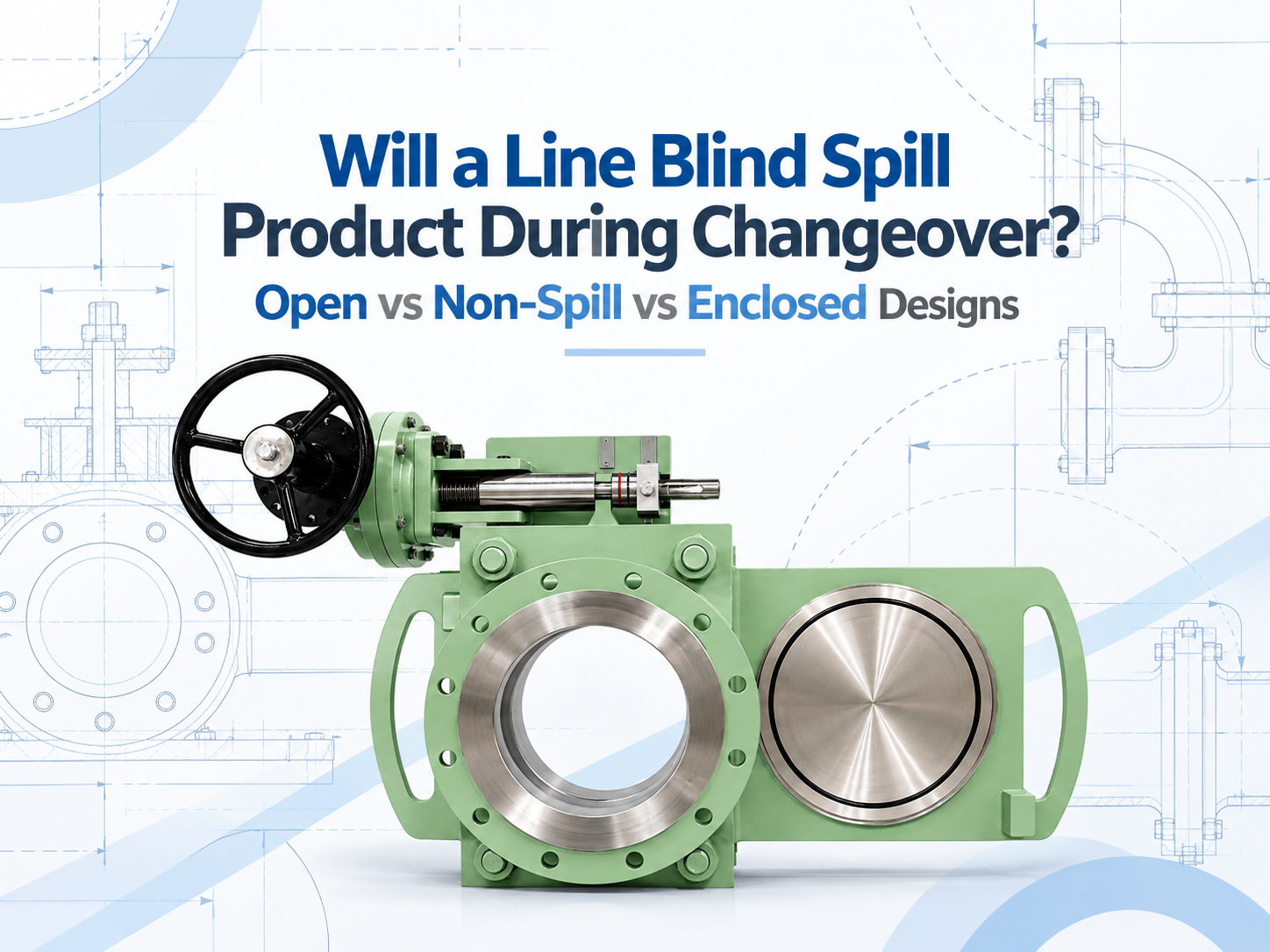
Yes, an open-body line blind can release residual product when it changes between the open and blind positions. A non-spill design does not make that residue disappear; it catches the liquid in a partial enclosure and directs it to a drain. An enclosed design can provide better control of liquid and vapour, but only when its housing, drain, vent and purge connections are engineered for the service. None of these labels should be read as permission to move the blind under live line pressure. Why Product Can Escape During Changeover When a line blind is fully clamped, its seals contain the process and the solid plate provides positive isolation in the blind position. Changeover is different. The sealing faces must separate before the spectacle or sliding plate can move. During that interval, the body cavity and plate path may be open to the surrounding area. The line should already be isolated, depressurised and drained, but “drained” rarely means perfectly dry. Liquid can remain as a film on the plate, collect in the lower body, or sit in a poorly drained pipe pocket. Gas service may leave flammable, toxic or odorous vapour. The amount released therefore depends as much on piping layout and the shutdown procedure as on the line blind itself. The Three Designs Manage Residue Differently Open-body design Residual liquid can drip from the exposed plate path into a temporary tray or the work area, while vapour disperses locally. This arrangement can suit water, steam condensate or other manageable media where easy access and visual inspection matter. It presents the highest potential for floor contamination and operator exposure. Non-spill design A bottom-and-side cover catches drips and sends them to a drain or recovery container; the top may remain open. This design is commonly considered for fuel terminals, marine service and liquid duties where ground or deck contamination must be controlled. It reduces dripping but may not contain vapour, and a blocked drain defeats its purpose. Enclosed design A housing surrounds more or all of the plate travel and may connect to a closed drain, purge, vent, flare or vapour-recovery system. It is better suited to toxic, flammable, odorous or environmentally sensitive service requiring controlled containment. The tradeoff is greater complexity in purging, inspection and maintenance, together with the need to manage trapped pressure deliberately. These names are not perfectly standardised across manufacturers. One supplier's “non-spill” model may be open at the top, while another product described as enclosed may use a more complete casing. The RFQ should show the enclosure arrangement and identify every opening rather than relying on the product name. Non-Spill Does Not Automatically Mean Zero Release For a liquid with low volatility, catching the remaining drops and routing them into a closed contai...
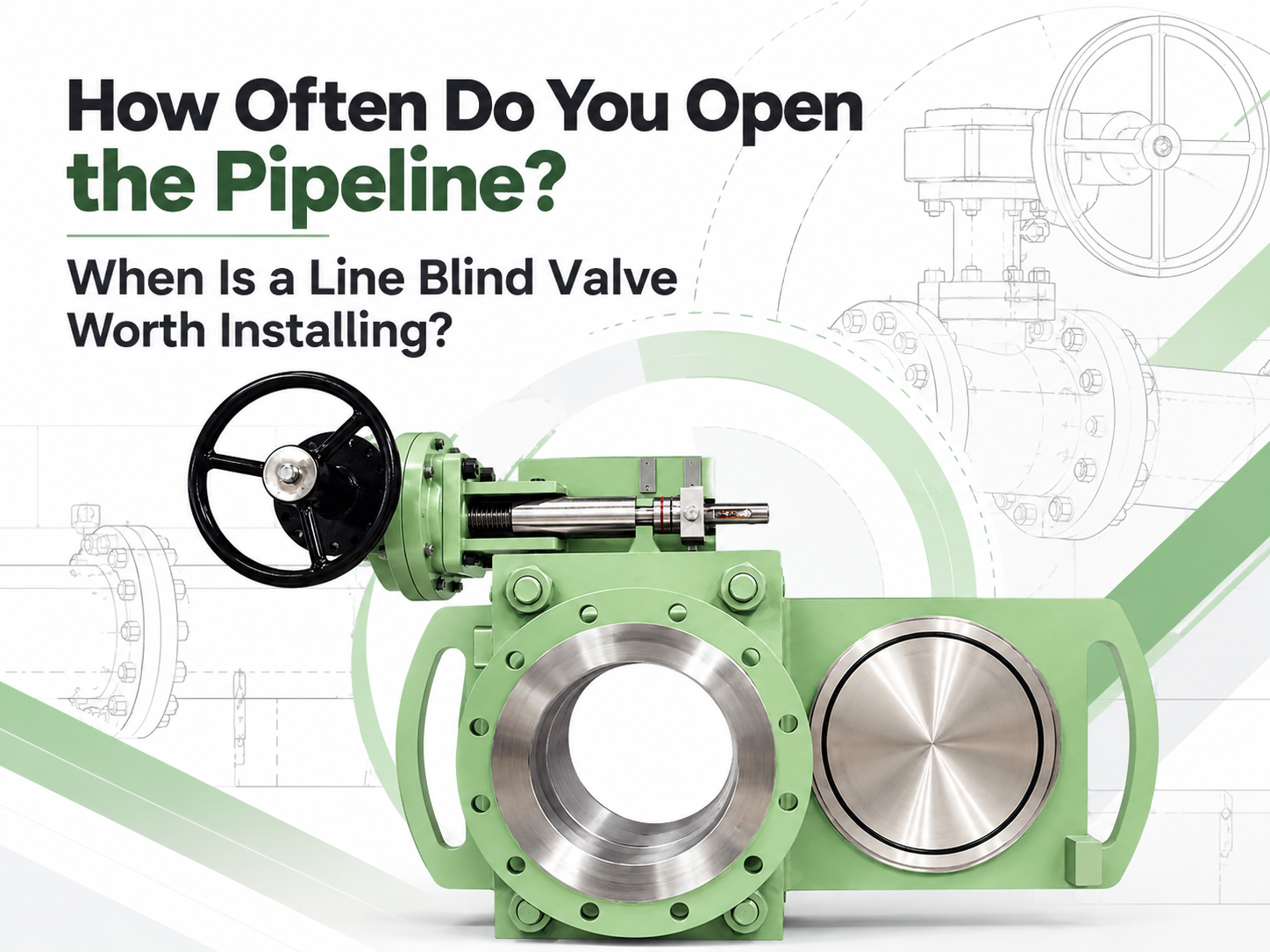
A line blind valve is worth evaluating when a pipeline is blinded several times a year, or when one conventional changeover causes hours of shutdown, lifting work or significant exposure to hazardous residue. No universal cycle count guarantees payback. A large critical line operated twice a year may justify the investment, while a small accessible line operated monthly may not. The decision should be based on the cost and risk of each complete isolation event, not frequency alone. There Is No Standard “Two Operations per Year” Rule Some suppliers use one or two annual changeovers as a screening threshold. That can start a discussion, but it is not an engineering rule. Frequency has very different consequences on a DN50 utility line and a DN600 process-gas main. For a preliminary review, the following bands are useful but not mandatory: Blinding frequency Initial interpretation Once per major turnaround or less A removable blind or spectacle blind is often more economical. One to three times per year Compare labor, lifting, outage duration and medium risk carefully. Quarterly to monthly A quick-action line blind is normally a strong candidate. Weekly or more often Purpose-built or automated isolation deserves detailed review; also confirm that a line blind is suitable for the required cycle duty. A low operating frequency can still support installation when every event requires scaffolding, a crane, several pipefitters or a long production interruption. Conversely, frequent operation does not justify a line blind if the process cannot accommodate its pressure, temperature, materials or maintenance needs. Count the Complete Changeover Traditional blinding is more than moving a plate. After the line is made safe, workers loosen bolting, spread the flange joint, handle the blind or spacer, replace gaskets, restore alignment, tighten the joint and complete leak checks. Large sizes add rigging and access equipment. A quick-action line blind keeps the spectacle or sliding plate supported inside the installed assembly. Manufacturer literature commonly reports one-person changeover in minutes rather than the man-hours needed for conventional flange work. Those figures are useful for screening, but the project calculation should use the plant’s own procedures and recorded shutdown times. Use a simple comparison: Annual avoided cost = operations per year x cost avoided per operation Avoided cost may include pipefitter hours, rigging, scaffolding, gaskets and bolting, leak testing and the production value of saved time. Keep categories separate to avoid double counting. Compare the annual saving with the line blind’s additional installed price and maintenance cost. Risk Can Matter More Than Simple Payback Repeated flange separation creates opportunities for residual-medium exposure, damaged flange faces, poor alignment and inconsistent bolt load...
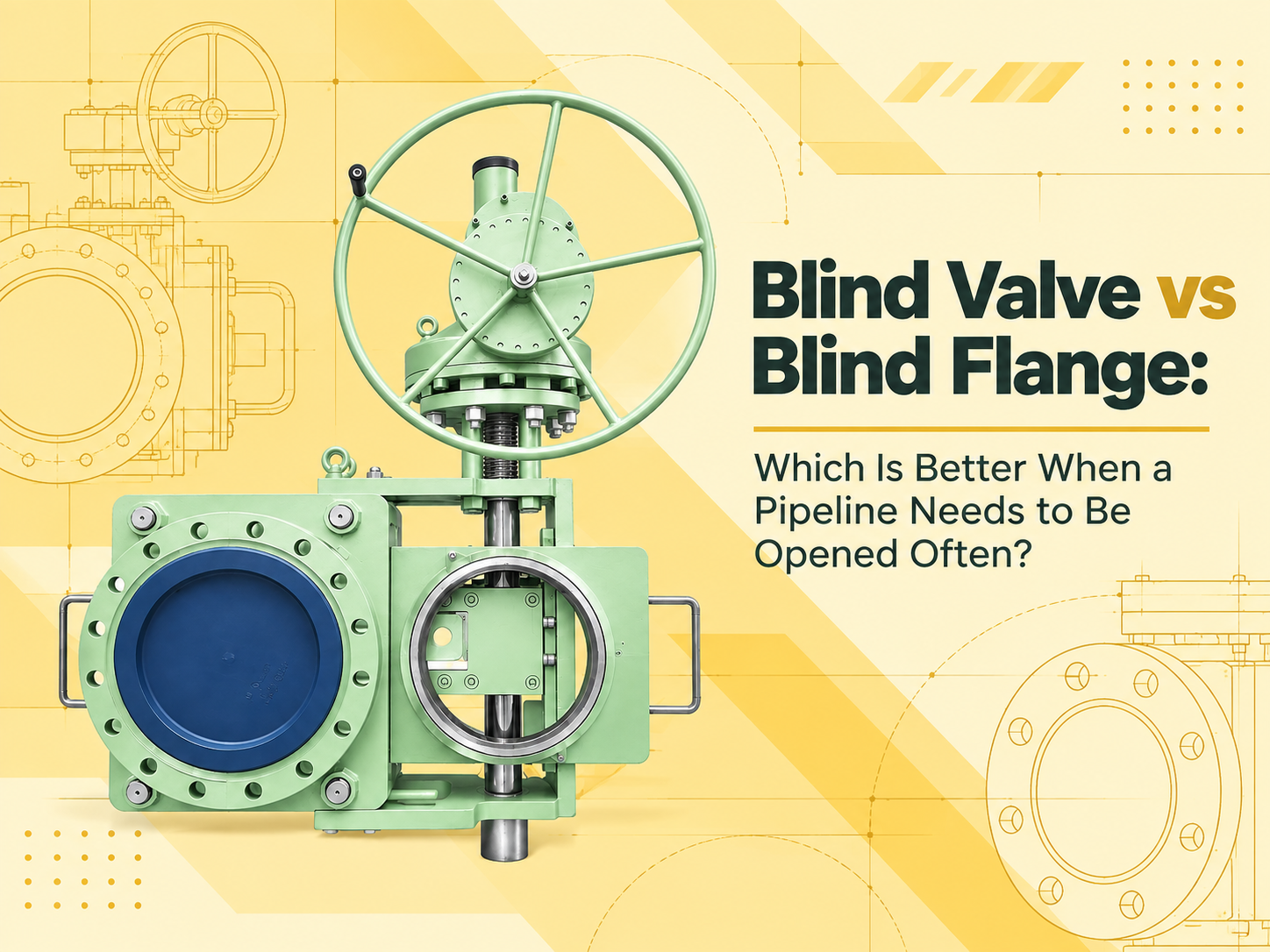
When a pipeline must be opened and positively isolated often, a line blind valve is usually the better choice. It keeps the blind mechanism permanently installed and lets operators change between open and blocked positions without repeatedly removing a bolted end closure. A blind flange costs less and has fewer moving parts, but it is better suited to closing a pipe end that will remain closed for long periods. This answer assumes that “blind flange” means a solid flange bolted to the end of a pipe or nozzle. A spectacle blind or a removable spade installed between two flanges is a different device, although it creates a similar solid-metal isolation barrier. Frequent Opening Changes the Cost Calculation The purchase price favors the blind flange. Its construction is simple, and maintenance is largely limited to checking the flange face, gasket, studs and nuts. If the closure will be disturbed only during an occasional turnaround, that simplicity is difficult to beat. Repeated opening changes the picture. Removing a blind flange requires the line to be shut down, depressurized, drained or purged, and verified safe. The bolts must then be loosened, the flange supported and the sealing faces separated. Larger flanges may require lifting equipment. Reassembly introduces a new gasket, controlled bolt tightening and a leak test. None of these steps is unusual, but repeating them turns a low-cost component into a labor-intensive operating method. A line blind valve also requires the line to be isolated and depressurized before changing position unless its approved design and operating procedure explicitly state otherwise. Its advantage is mechanical handling: the plate, spacer or sliding element remains captured in the body, and the mechanism separates, moves and reclamps the sealing faces. Manual gearing may suit moderate operating forces; electric, pneumatic or hydraulic actuation may be justified for large sizes or remote operation. The Blind Valve Reduces Handling but Adds Equipment to Maintain For frequent switching, a blind valve can shorten the task and reduce repeated handling of heavy plates, bolts and gaskets. Its open or closed position is normally visible from the external plate or position indication, which helps field verification. It also avoids repeatedly forcing connected piping apart to insert or remove a blind. Those benefits come with additional maintenance. Guides, screws, gearboxes, hydraulic components, seals and interlocks must remain functional. Product deposits or corrosion can obstruct plate travel, while damaged sealing surfaces can prevent reliable reclamping. The installation therefore needs drainage, cleaning access and enough surrounding clearance to complete the full movement and service the mechanism. A blind flange has no operating mechanism to seize. However, frequent removal can damage flange faces, stretch or corrode bolting, disturb pipe al...
Payment:
30% T/T When Order, 70% T/T Before ShipmentProduct Origin:
ChinaColor:
CustomizationShipping Port:
Shanghai ChinaLead Time:
30~55 days Ex Works After Order ConfirmationMaterial:
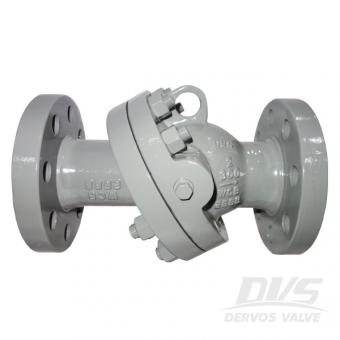
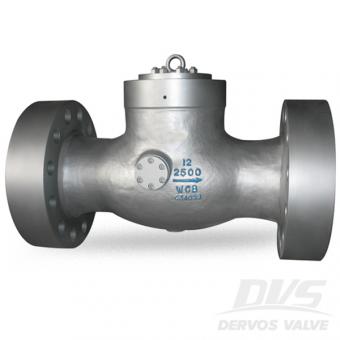
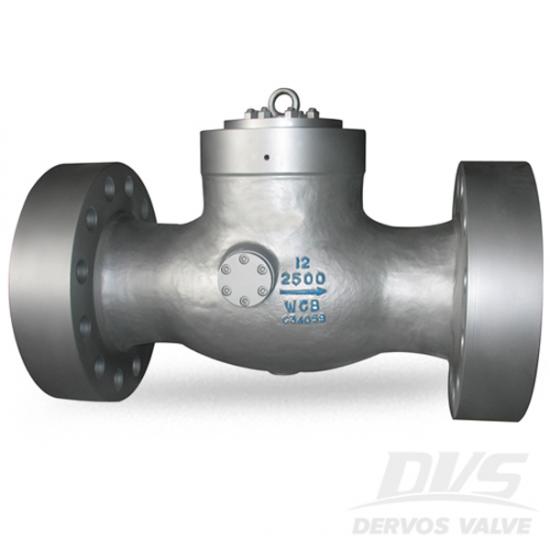
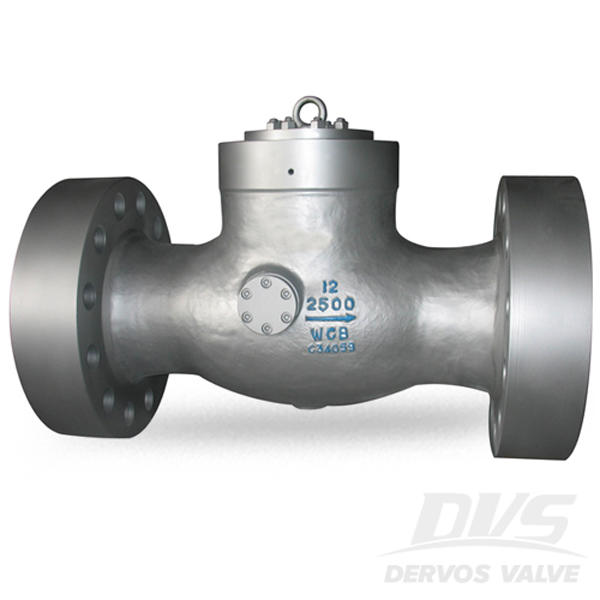
Cast Steel Check Valve, Carbon Steel Check ValveThe 12 inch high pressure check valve is designed with pressure seal bonnet, RTJ flange, tilting disc, made of carbon steel WCB body and hard face sealing.
Quick Detail
|
Type |
Check Valve |
|
Size |
12'' |
|
DesignPressure |
2500LB |
|
Construction |
Pressure Seal Bonnet, Tilting Disc Type |
|
Connection |
RTJ Flange |
|
Design & Manufacture |
ASME B16.34 |
|
End to End |
ASME B16.10 |
|
Connection |
ASME B16.5 |
|
Pressure & Temp |
ASME B16.34 |
|
Test & Inspection |
API 598 |
|
Body Material |
A216 WCB |
|
Trim Material |
13CR+STL |
|
Temp Range |
-29℃~+350℃ |
|
Media |
W.O.G. |
Product Range
Body Material Range: WCB, WCC, WC1,CF8M, CF8, CF3, CF3M, LCB, LCC
Size Range: 2”~60” (DN50~DN1500)
End Connection Type: Flange End, Weld End
Design Pressure Range: 150lbs~600lbs
Temp Range: -46℃~ +425℃
Related Knowledge
What is a tilting disc check valve?
The disc of a tilting disc check valve has a pivot point at the center of it. It is desinged to overcome weaknesses of general type swing check valve.
Compared to swing type check valve, the tilting check valve could remain fully open and steady at lower flow rates. That is to say, the swing check valve needs a high velocity of fluid to keep disc open and a higher cracking pressure.
For low pressure situation, the pressure drop of a tilting disc check valve is much lower than the swing type. But at a higher flow rate, the tilting check valve has higher pressure drop than swing type.
If you are interested in our products and want to know more details,please leave a message here,we will reply you as soon as we can.
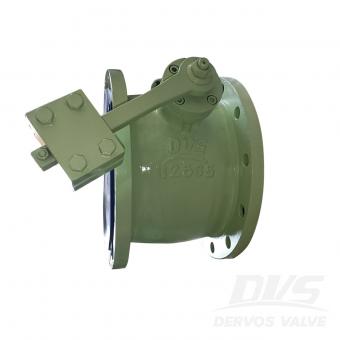
DN250 PN10 check valve body is made of A216 WCB+STL. It has the structural characteristics of heavy hammer on both sides and flange type. Its connection mode is RF.
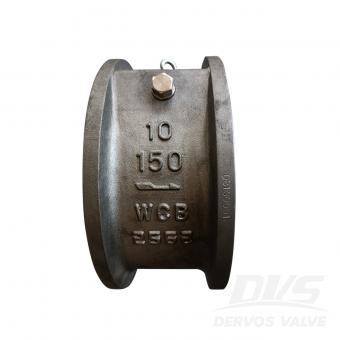
10" 150LB tilting disc check valve is made according to API 6D standard. The valve body is made of A216 WCB+SS316. It has the structural characteristics of swash plate type. Its connection mode is wafer.
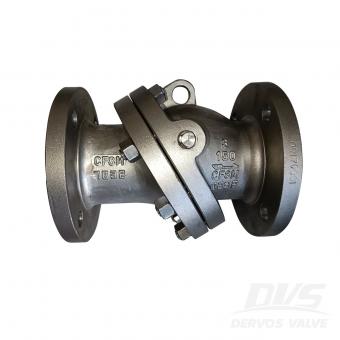
3" 150LB tilting disc check valve is made according to API 6D & BS1868 standard. The valve body is made of ASTM A351 CF8M. It has the structural characteristics of tilting disc type, bolt cover. Its connection mode is RF.
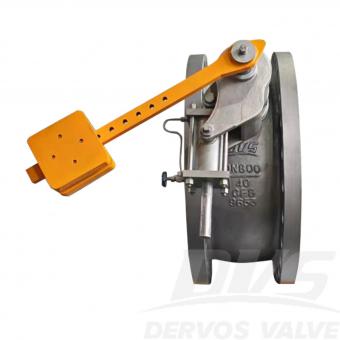
DN800 PN40 Butterfly Type Non-Slam Check Valve is made according to CJ/T 282 standard. The valve body is made of A351CF8+STL. It has the structural characteristics of Equipped with Hydraulic Cylinder and Counterweight. Its connection mode is EF. Product Parameters Type Butterfly Type Non-Slam Check Valve Size DN800 Pressure PN40 Connection EF Body Material A351 CF8+STL Design Norm CJ/T 282 Flange Standard GOST33259 Dimension Standard GB/T12221 Test & Inspection Code GOST9544 A Temperature -45 ~ 248°C Applicable Medium Water Features 1.Butterfly-type non-slam design minimizes water hammer and ensures smooth, rapid closure in large-diameter pipelines. 2.Manufactured in accordance with CJ/T 282, rated PN40 for reliable performance in municipal and industrial systems. Technical Drawing Dimension Checking Pressure Testing Flange Inspection Report
Copyright © 2015-2026 DERVOS VALVE CO.,LTD.All Rights Reserved Blog / Sitemap / XML / Privacy Policy