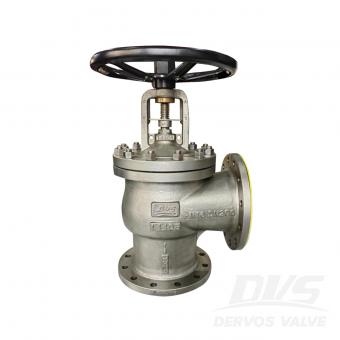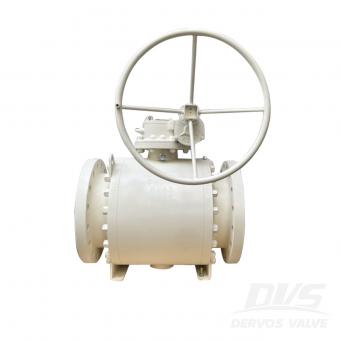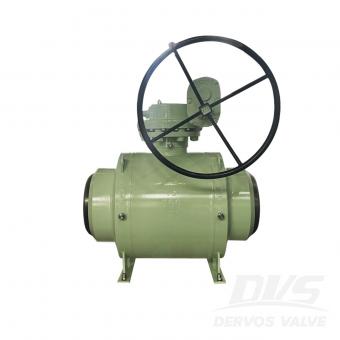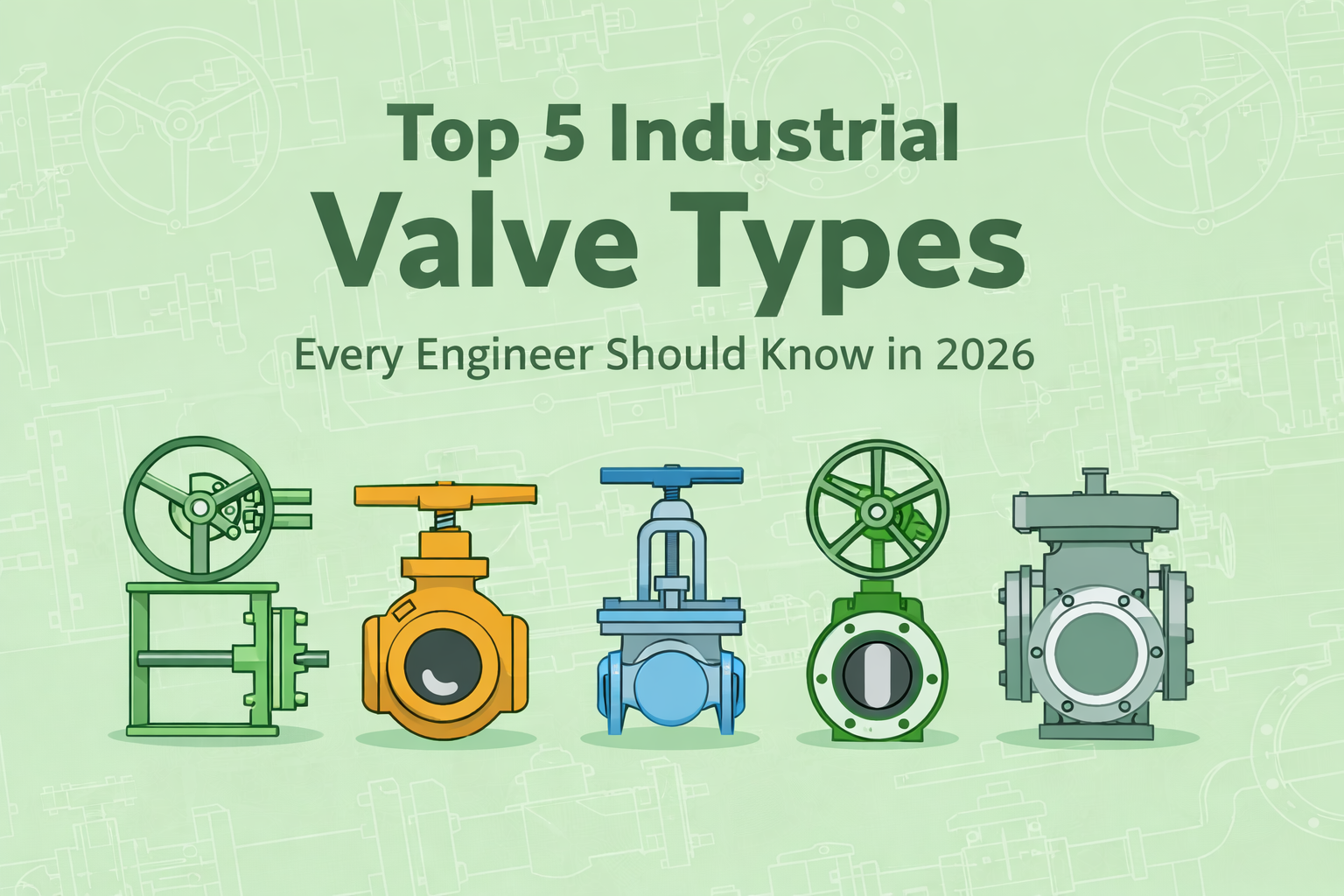
Choosing the right industrial valve type is one of the most critical decisions in system design. A poor selection—even when using high-quality valves—can lead to leakage, pressure loss, vibration, frequent maintenance, and long-term operational inefficiency. This guide covers the main industrial valve types, their applications, advantages, and limitations, along with practical insights to help you make the right valve selection for your project in 2026. What Are Industrial Valve Types? Industrial valve types refer to different valve designs used to control, regulate, or isolate fluid flow in piping systems. Each type is engineered for a specific function—such as shut-off, throttling, or backflow prevention—and selecting the correct type is essential for system safety and efficiency. 5 Main Industrial Valve Types and Their Applications 1. Ball Valve Best for: Quick shut-off and low pressure drop Ball valves use a rotating ball with a straight-through bore. When fully open, they provide minimal resistance, making them one of the most efficient options for fluid transmission. Common applications: ● Oil and gas pipelines ● High-pressure systems ● Frequent on/off operations Selection notes: ● Full-port designs minimize energy loss ● Metal-seated ball valves perform better in abrasive or high-cycle conditions Avoid if:Precise flow control is required. Throttling with a ball valve can damage sealing surfaces over time. 2. Gate Valve Best for: Isolation service with minimal flow resistance Gate valves operate by lifting a gate out of the flow path. They are widely used in large-diameter pipelines where full open or full close operation is required. Common applications: ● Long-distance transmission pipelines ● Water treatment systems ● High-temperature steam lines Selection notes: ● Near-zero pressure drop when fully open ● Wedge gate valves provide better sealing in high-temperature conditions Avoid if:Frequent operation or throttling is required. Gate valves are not designed for repeated cycling. 3. Globe Valve Best for: Precise flow regulation Globe valves force fluid through a controlled flow path, allowing accurate throttling and stable flow control. Common applications: ● Steam systems ● High-temperature processes ● Flow regulation applications Selection notes: ● Excellent throttling performance ● Stable operation under fluctuating flow conditions Avoid if:Pressure drop must be minimized. Globe valves inherently create higher flow resistance. 4. Check Valve Best for: Automatic backflow prevention Check valves operate automatically based on flow directi...

Recently, Dervos Valve helped a client in Hungary overcome a common challenge in industrial steam systems: how to safely isolate high-temperature pipelines without leakage or downtime. Operating with saturated steam at around 250°C and exposed to temperatures as low as -39°C, the client’s system demanded a solution that was both robust and reliable. Traditional valves often failed to maintain a tight seal under such conditions, and conventional isolation methods required depressurizing the line, increasing downtime and operational risk. To address these challenges, Dervos supplied a DN400 PN40 sliding line blind valve, engineered specifically for the project’s harsh conditions. The valve’s sliding blind mechanism allows operators to switch between flow and isolation positions without depressurizing the system, enhancing safety and efficiency during maintenance. Built with forged 20GML steel and a metal-to-metal stainless steel sealing structure, the valve delivers reliable performance under both high-temperature steam and extreme outdoor climates. Its full-bore design minimizes flow resistance, while the worm gear manual actuator ensures smooth and controlled operation even at large sizes and high pressure ratings. Safety features such as anti-misoperation devices and protective blind plate structures further reduce the risk of errors during handling. Since installation, the valve has enabled leak-free operation, safer maintenance procedures, and stable performance in extreme temperatures. Designed for a service life exceeding 30 years, it provides a long-term, low-maintenance solution, giving the client confidence in their steam system’s reliability and safety. This project highlights how a carefully engineered sliding line blind valve can solve critical isolation challenges in high-temperature steam applications, combining operational safety, durability, and efficiency in one solution.
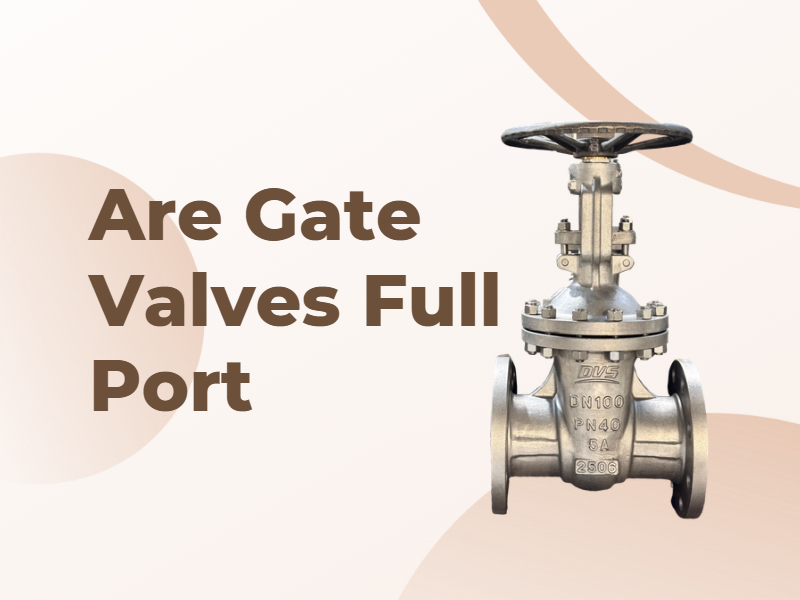
In industrial piping systems, gate valves are generally considered low-resistance isolation valves. When the valve is fully open, the gate is completely withdrawn from the flow path, allowing the fluid to pass through with minimal obstruction. However, from a strict engineering perspective, not all gate valves are classified as full port valves. If the seat bore is equal to or very close to the pipeline internal diameter, the flow experiences little or no restriction. In this case, the valve can be considered full port (or near full port). This design is commonly used in oil and gas pipelines, water transmission systems, and other applications where low pressure drop is required. If the seat bore is slightly smaller than the pipe internal diameter, a minor flow restriction will occur inside the valve. In such cases, the valve is more accurately described as reduced bore. This configuration is more common in smaller sizes or cost-optimized valve designs. In engineering practice, a simple selection logic can be applied: ● If the system requires minimum flow resistance or pipeline pigging, the valve bore must match the pipeline diameter. ● If the valve is used for general isolation purposes, most standard gate valves can already meet the required flow capacity. Therefore, a concise conclusion can be drawn: Gate valves are typically close to full port designs, but whether they are truly full bore depends on whether the seat bore equals the pipeline internal diameter. QA Q1: Are gate valves always full bore?Not necessarily. If the seat bore equals the pipe internal diameter, the valve can be considered full bore. If it is slightly smaller, it is classified as reduced bore. Q2: Why do gate valves have relatively low flow resistance?When the valve is fully open, the gate is completely removed from the flow path, allowing the fluid to pass through in a nearly straight line, which results in low pressure drop. Q3: Are gate valves suitable for high-flow pipelines?Yes. If the system requires low pressure drop, gate valves are commonly used. Q4: Is the concept of full port the same for gate valves and ball valves?Not exactly. For ball valves, the bore size is determined by the ball port diameter, while for gate valves, it is mainly determined by the seat bore diameter.
Payment:
30% T/T When Order, 70% T/T Before ShipmentProduct Origin:
ChinaColor:
CustomizationShipping Port:
Shanghai ChinaLead Time:
30~55 days Ex Works After Order ConfirmationMaterial:
Stainless SteelMethod of Operation:
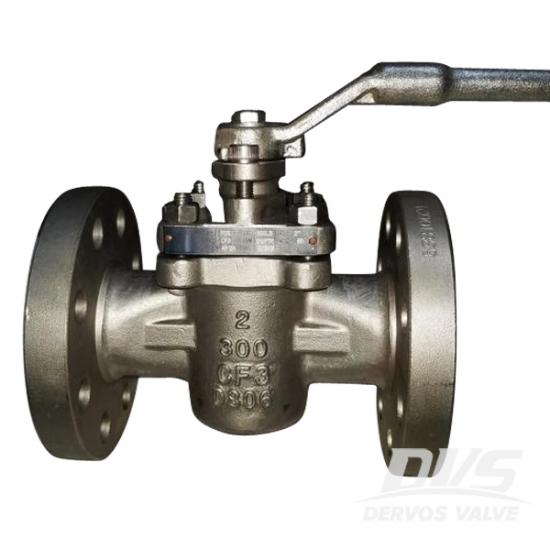
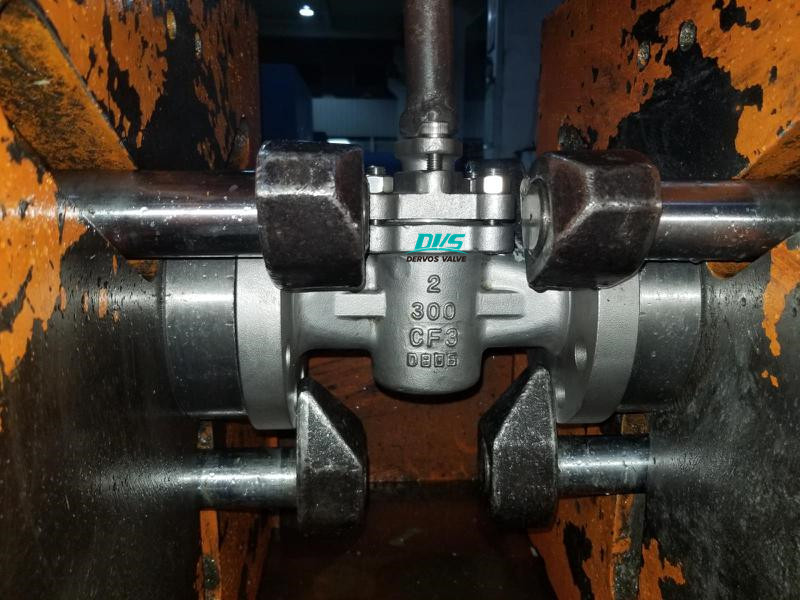
LeverThe PTFE sleeved plug valve is made of CF3 body and plug as per API 6D. The valve owns the feature of reduced port and good sealing performance. We call this type of valve as non lubricated plug valve or self lubricated plug valve.
Quick Detail
|
Type |
Plug Valve |
|
Size |
2'' |
|
DesignPressure |
300LB |
|
Construction |
Sleeved Type, Non Lubricated Type, Soft Seat |
|
ConnectionType |
Flange |
|
Operation |
Lever Operation |
|
Design Code |
API 599, API 6D |
|
Face to Face |
ASME B16.10 |
|
End Connection |
ASME B16.5 |
|
Pressure & Temp |
ASME B16.34 |
|
Test & Inspection |
API 598 |
|
Body Material |
CF3 |
|
Temperature Range |
-29℃~+120℃ |
|
Application |
Water, Oil, Gas |
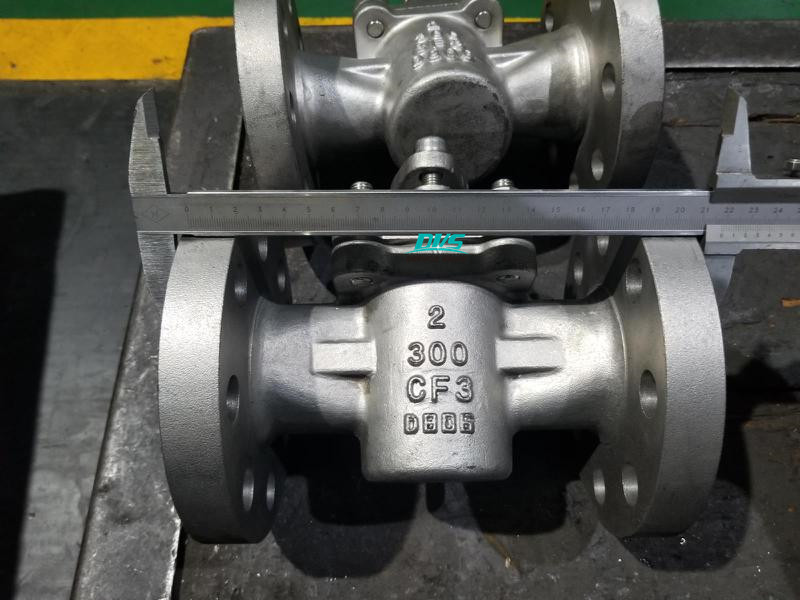
Dimension Checking
Hydrostatic Testing
If you are interested in our products and want to know more details,please leave a message here,we will reply you as soon as we can.
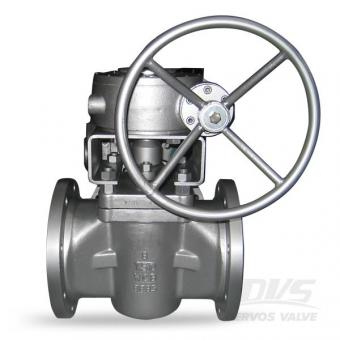
The 6 inch sleeved plug valve features in non lubricated design and soft seat. The full port plug valve is made of carbon steel body and PTFE seat as per API 6D, with Class 150 flange connection. Quick Detail Type Plug Valve Size 6'' Design Pressure 150LB Construction Self-Lubricated Type, Sleeved Type, Soft Seat Connection Type RF Flange Operation Gearbox Operation Design Code API 599 Face to Face ASME B16.10 End Connection ASME B16.5 Pressure & Temp ASME B16.34 Test & Inspection API 598 Body Material A216 WCB Temperature Range -29℃~+425℃ Application Water, Oil, Gas Material & Dimension No Part Name Carbon steel to ASTM Stainless steel to ASTM WCB LCB CF8 CF8M CF3 CF3M 1 Body A216 WCB A350 LCB A351 CF8 A351 CF8M A351 CF3 A351 CF3M 2 Bonnet A216 WCB A350 LCB A351 CF8 A351 CF8M A351 CF3 A351 CF3M 3 Plug A105 A182 F304 A351 CF8 A351 CF8M A351 CF3 A351 CF3M 4 Stem A182 F6 A182 F6 A182 F304 A182 F316 A182 F304L A182 F316L 5 Seat Ring PTFE 6 Gasket PTFE or Stainless Steel and Graphite 7 Stem Seat PTFE PTFE PTFE PTFE PTFE PTFE 8 Small spring 17-17PH 9 Small ball A182 F304 or A182 F316 10 Gland A182 F6 A182 F6 A182 F304 A182 F316 A182 F304L A182 F316L 11 Gland Flange A216 WCB A350 LCB A351 CF8 A351 CF8M A351 CF3 A351 CF3M 12 Stem packing PTFE or Graphite 13 Bonnet bolt A193 B7 or A320 L7 or A320 B8 or A193 B8M 14 Bonnet nut A194 2H or A194 4 or A194 8 Class 150 DN mm 15 20 25 40 50 65 80 100 150 200 250 300 NPS in 1/2 3/4 1 1 1/2 2 2 1/2 3 4 6 8 10 12 L(RF) mm 108 117 127 165 178 191 203 229 394 457 533 610 in 4.25 4.6 5 6.5 7 7.5 8 9 15.5 18 21 24 L1(BW) mm 140 152 165 190 216 241 283 305 457 521 559 635 in 5.5 6 6.5 7.48 8.5 9.5 11.13 12 18 20.5 22 25 L2(RTJ) mm 119 129.7 139.7 178 191 203 216 241 406 470 546 622 in 4.69 5.11 5.5 6.9 7.5 8 8.5 905 16 18.5 21.5 24.5 H mm 59 63 75 92 153 165 195 213 272 342 495 580 in 2.3 2.5 2.95 3.74 6.02 6.5 7.68 8.39 10.7 13.5 19.5 22.85 D(W) mm 130 130 160 230 400 400 600 850 1100 1500 350* 350* in 5.1 5.1 6.3 9 15.74 15.74 23.62 33.46 43.3 59 13.8 13.8 Weight (Kg) RF 2.3 3 4.5 7 15 20 25 40 97 160 240 390 BW 2.0 2.5 3.8 5.8 12 17 21 36 92.8 154 227 365
This 1/2 Inch plug valve is made of A216 WCB, according to API598.With little required maintenance and trouble-free operation, a high integrity bubble-tight seal is provided both in-line and to atmosphere.
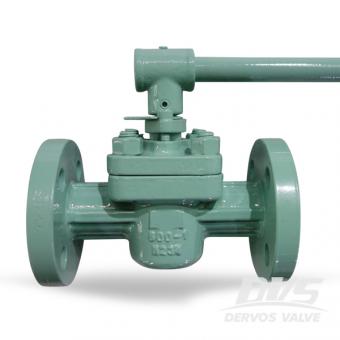
The 1 inch sleeved type plug valve is made of A216 WCB as per API 599. Thanks to its PTFE seat, the valve has excellent sealing and anti-corrosion performance. The valve is capable in working condition lower than 180 degree.
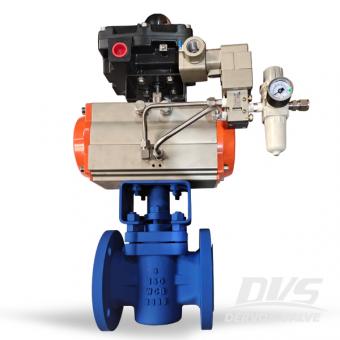
Non-Lubricated, Sleeved Plug Valves incorporate state-of-the-artPPL seat design. With little required maintenance and trouble-free operation, the 3 inch 150 LB valve will ensure a high integrity bubble-tight seal.
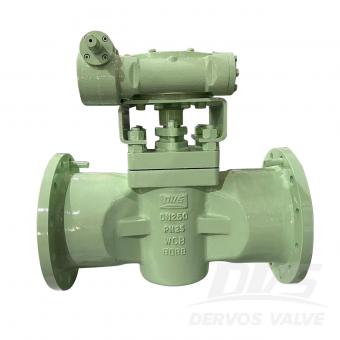
DN250 PN25 plug valve is made according to API599 standard. The valve body is made of A216 WCB. It has the structural characteristics of soft sealing plug valve. Its connection mode is RF. And it has turbine operation mode.
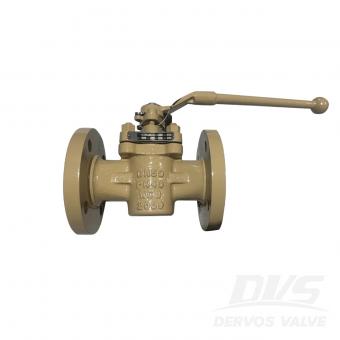
DN50 PN40 plug valve is made according to API 599 standard. The valve body is made of A216 WCB. It has the structural characteristics of ferrule type, reduced diameter. Its connection mode is RF. And it has lever operation mode.
Copyright © 2015-2026 DERVOS VALVE CO.,LTD.All Rights Reserved Blog / Sitemap / XML / Privacy Policy