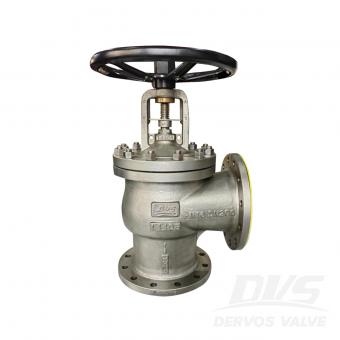
A bellows seal globe valve (also known as a bellows-sealed globe valve) uses an automatically roll-welded metal bellows to form a metallic barrier between the process medium and the atmosphere, achieving a zero-stem-leakage design.
Inside the valve, the stainless-steel bellows assembly is welded to the stem at its lower end to prevent the process fluid from contacting and corroding the stem. The upper end is positioned between the valve body and bonnet to create a static seal.
A double sealing system is adopted: if the bellows fails, the stem packing provides secondary sealing to prevent leakage. The bellows is welded to the stem to maintain stable operation and to minimize stem vibration caused by plug/disc movement.
Depending on application context and regional terminology, a bellows seal globe valve is also commonly referred to as a bellows-sealed globe valve. Compared with a conventional globe valve, it provides no external leakage, making it safer for hazardous media service.
The valve uses a flexible, hermetically sealed metal bellows capable of expansion and compression to replace traditional packing sealing, effectively preventing external leakage caused by packing wear or deterioration.
It is typically used for permeating or fugitive media, such as hydrogen service. As long as the bellows remains intact, external leakage is essentially eliminated. By contrast, a conventional globe valve relies on packing sealing, which is more prone to leakage over time.
Compared with a conventional globe valve, a bellows seal globe valve provides superior sealing reliability. A standard globe valve uses packing sealing, where relative sliding occurs between the stem and packing, making leakage more likely under low-temperature conditions.
The bellows seal globe valve incorporates a metal bellows assembly inside the valve. The lower end of the stainless-steel bellows is welded to the valve stem to prevent process media from attacking the stem, while the upper end is sealed between the body and bonnet to form a static seal.
A dual sealing system (bellows + packing) is adopted: if the bellows fails, the stem packing still prevents leakage. The welded bellows also stabilizes operation and prevents stem vibration caused by disc oscillation.
The bellows seal globe valve represents a specialized subtype within the broader category of steam service globe valves. Conventional globe valves can also be used in steam systems. Therefore, a bellows seal globe valve can be considered a steam globe valve, but a steam globe valve is not necessarily a bellows seal type.
External leakage can usually be handled systematically through inspection and maintenance:
Bonnet joint leakage: Retighten the bonnet flange bolts. If leakage persists, inspect the bonnet gasket for damage.
Packing leakage: Tighten the gland follower; if packing is insufficient, add additional packing.
Body leakage: For low pressure, repair welding may be possible; for high pressure service, welding is unsafe and not recommended.
Internal leakage: Causes vary and should be inspected step-by-step before maintenance.
Dual sealing system (bellows + packing) — packing provides backup sealing if the bellows fails and complies with international leakage control requirements.
No fugitive emission loss, reducing energy loss and improving plant safety.
Long service life, reducing maintenance frequency and operating cost.
Robust bellows sealing design ensures zero stem leakage and enables maintenance-free operation.
PTFE soft seat available for gas service to improve sealing performance.
Hard conical seat for high temperature ≤ 425 °C, achieving tight shut-off performance.
Copyright © 2015-2026 DERVOS VALVE CO.,LTD.All Rights Reserved Blog / Sitemap / XML / Privacy Policy