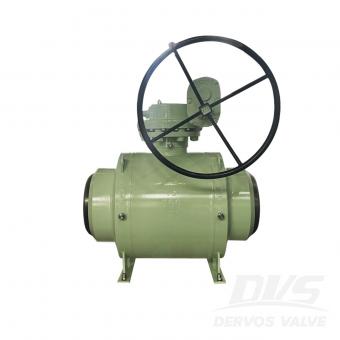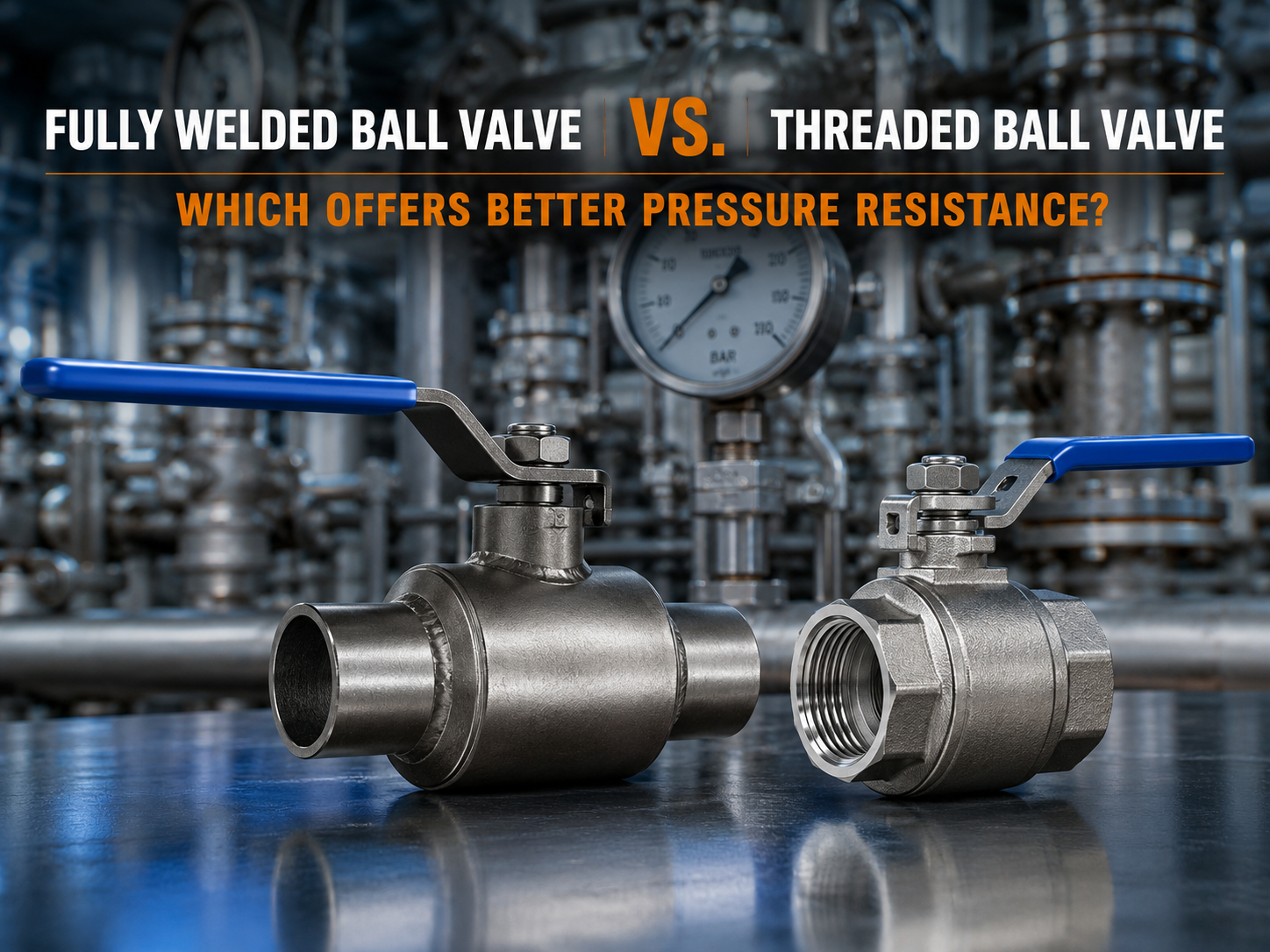
In natural gas transmission, district heating networks, petrochemical facilities, and industrial utility systems, ball valves are widely used for reliable flow isolation. One of the most common questions during valve selection is: Which provides better pressure resistance—a fully welded ball valve or a threaded ball valve? Understanding the Structural Difference Between Fully Welded and Threaded Ball Valves From a structural perspective, fully welded ball valves generally offer higher pressure-bearing capability. The valve body is manufactured using a fully welded construction, eliminating threaded body connections and reducing stress concentration points associated with mechanical joints. Under high-pressure conditions, frequent pressure fluctuations, or significant temperature changes, the welded structure can provide greater mechanical integrity and more stable sealing performance. Threaded ball valves, by contrast, rely on threaded connections to assemble the valve body. While this design simplifies installation and maintenance, threaded joints are inherently more susceptible to stress and deformation. As system pressure increases or when vibration and thermal expansion-contraction cycles are present, threaded connections may become vulnerable to loosening, potentially resulting in external leakage. Common field indications include leakage around the stem packing area, seepage from body connections, or accelerated wear of sealing components. Why Fully Welded Ball Valves Typically Offer Higher Pressure Resistance The primary advantage of a fully welded ball valve lies in its one-piece welded body construction. Without threaded body joints, the valve can better withstand internal pressure loads and reduce the possibility of leakage caused by connection failure. In applications involving high operating pressures, pressure surges, or repeated thermal cycles, the welded structure maintains better dimensional stability and structural strength. This is one of the key reasons why fully welded ball valves are widely used in gas transmission pipelines, district heating systems, and other critical infrastructure projects. How Sealing Performance Affects Pressure Capability In high-pressure service, valve failure is not determined solely by body strength. The sealing system also plays a critical role. Fully welded ball valves typically utilize an integral body design that minimizes potential external leakage paths and provides more consistent support for the seat sealing surfaces. In threaded ball valves, small dimensional changes at threaded joints during long-term pressure cycling may affect seat loading, potentially increasing the risk of internal leakage. If significant leakage, abnormal deformation, or pressure test failure is observed, the valve should be removed from service and inspected immediately. For flammable, toxic, or high-temperature media, disassembly and maintenance under pre...
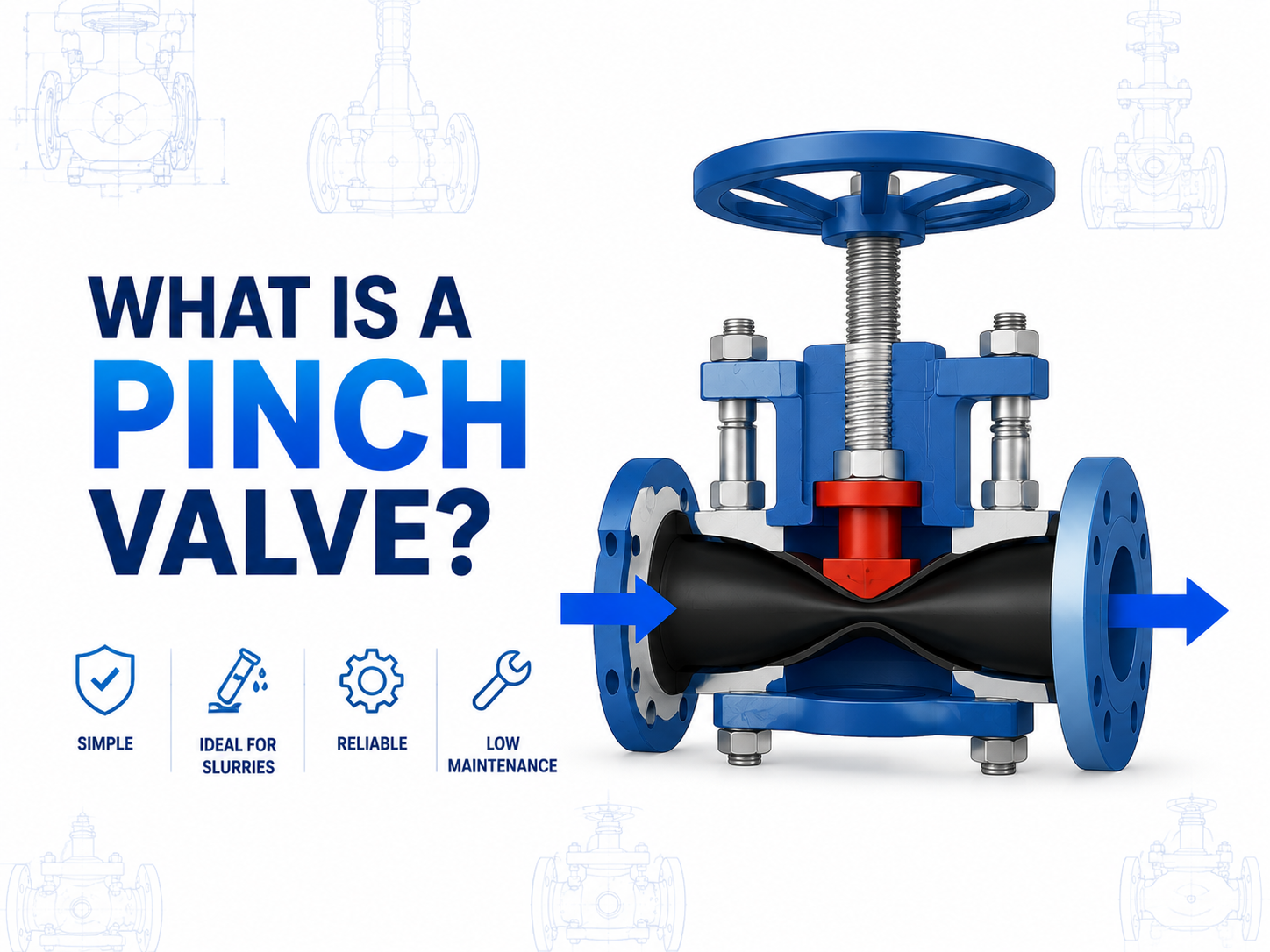
Introduction A pinch valve is a type of linear valve in which the flow of fluid is controlled by compressing a flexible sleeve. Unlike conventional metal-seated valves, pinch valves rely on a resilient elastomer tube that is “pinched” closed by a mechanical or pneumatic actuator to stop or regulate flow. This design allows full-bore flow with minimal obstruction when open and tight shut-off when closed, making pinch valves suitable for abrasive, corrosive, or slurry-type media. Pinch valves are used across industries such as water and wastewater treatment, chemical processing, mining, pneumatic conveying, and slurry handling. Their simple structure and minimal internal components make them resistant to clogging, easy to maintain, and particularly effective in systems where suspended solids or corrosive chemicals are present. Structure and Working Principle The key element of a pinch valve is its elastomer sleeve, which serves as both the sealing surface and the flow channel. When the actuator compresses the sleeve against the valve body, the valve closes and prevents fluid passage. Releasing the pinch pressure allows the sleeve to return to its original shape, enabling full flow. Valves may have manual, pneumatic, or electric actuators. The sleeve material—commonly natural rubber, EPDM, NBR, or specialty compounds—is selected based on chemical compatibility, temperature limits, and abrasion resistance. The valve body, typically made of carbon steel, stainless steel, or plastic, provides structural support and pressure containment. Key Advantages and Engineering Considerations Pinch valves are appreciated for their simplicity and reliability in handling challenging fluids. Because the sleeve is the only wetted component, there is minimal contact between the media and the valve body, reducing corrosion risk. They are inherently “full bore,” which minimizes pressure drop and makes them suitable for high-solids content flows. However, their performance depends heavily on proper sleeve selection, pinch force, and actuator alignment. Misapplication—such as exceeding temperature limits, using incompatible chemicals, or operating with high-pressure abrasive slurry—can accelerate sleeve wear, affect sealing integrity, or shorten service life. For engineers and procurement professionals, specifying the correct sleeve material, actuator type, and pressure rating is crucial to ensure reliable operation. Practical Advice for Industrial Use Maintenance is generally straightforward: sleeve inspection, replacement schedules, and actuator calibration are the main tasks. In critical systems handling toxic, flammable, or high-temperature media, maintenance must follow strict lockout-tagout and isolation procedures. Selecting a sleeve material with both chemical resistance and abrasion tolerance is key to extending service life, while actuator force ...
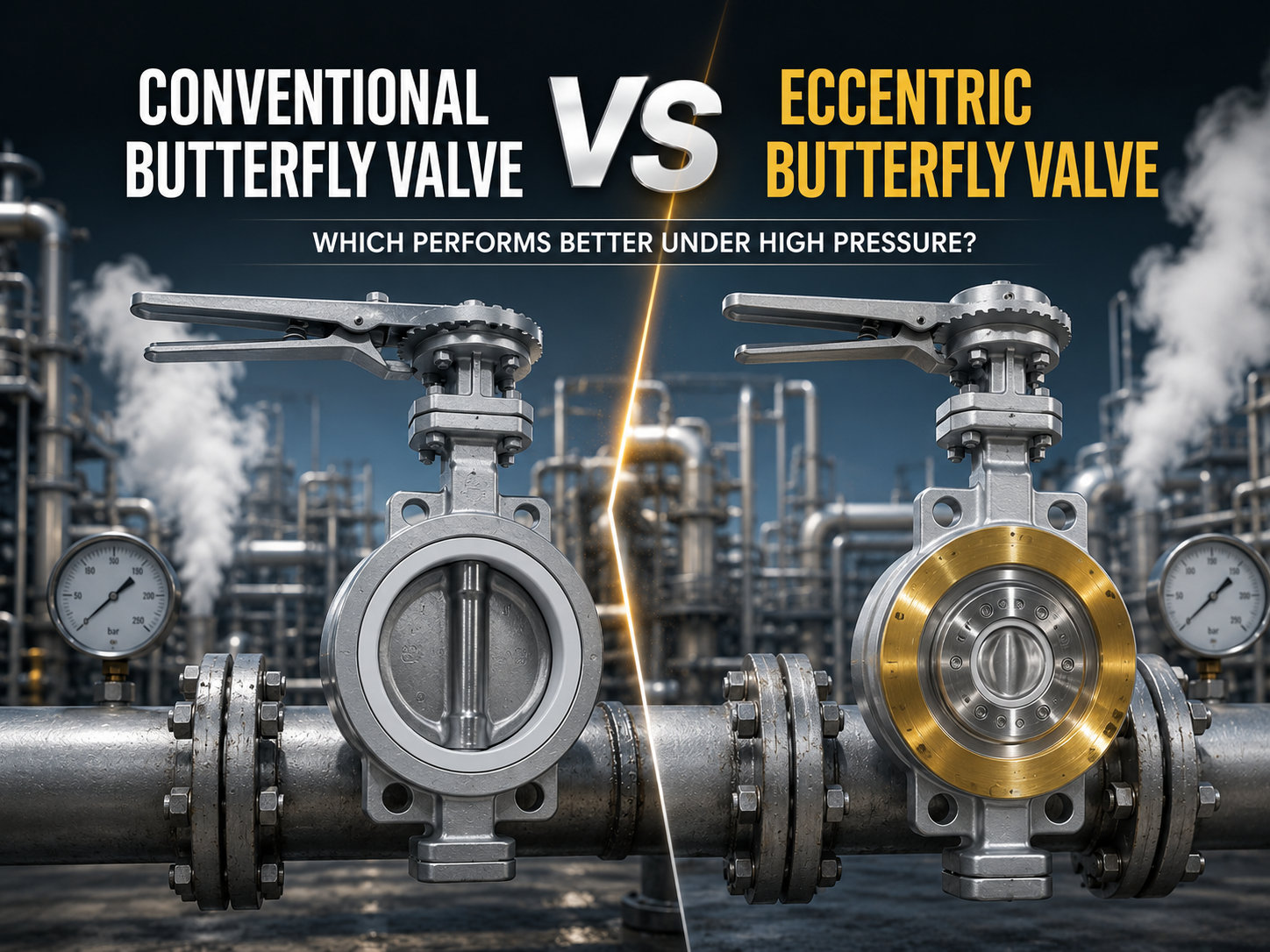
Butterfly valves are widely used in industrial piping systems, but pressure capability depends heavily on valve design and operating conditions. In many projects, engineers initially compare conventional butterfly valves and eccentric butterfly valves based on pressure class alone. In actual service, sealing reliability, temperature, cycling frequency, and media condition usually have a greater impact on long-term performance. A conventional butterfly valve uses a centered disc and stem arrangement. The disc stays in continuous contact with the seat during operation. This design is suitable for clean water systems, HVAC pipelines, cooling water service, and general utility applications where pressure and temperature remain relatively stable. Under higher pressure conditions, several limitations become more noticeable: ● seat wear increases because of continuous friction ● operating torque gradually rises ● leakage risk becomes higher after repeated cycling ● elastomer seats may deform under pressure fluctuation In saturated steam service, resilient-seated butterfly valves often experience early sealing problems when temperature exceeds the seat material limit. Even if pressure is technically acceptable, thermal aging can harden the seat and reduce shutoff reliability. Eccentric butterfly valves were developed to reduce these problems. Double-offset and triple-offset designs allow the disc to separate from the seat during most of the operating stroke. This reduces friction and lowers seat damage during repeated opening and closing. For high-pressure industrial systems, eccentric butterfly valves usually provide more stable sealing performance because the sealing surfaces experience less mechanical wear. Why Eccentric Butterfly Valves Handle High Pressure Better The biggest advantage of eccentric butterfly valves is not simply higher pressure rating. The main benefit is improved sealing stability under severe operating conditions. In refinery piping, power plant steam systems, and high-pressure hydrocarbon lines, triple-offset butterfly valves are commonly selected because metal seats tolerate temperature fluctuation more effectively than soft seats. This becomes important in conditions such as: ● saturated steam service ● thermal oil pipelines ● high-cycle automated isolation ● high differential pressure systems ● elevated temperature applications When pressure and temperature increase together, conventional butterfly valves often develop sealing instability faster than eccentric designs. Thermal expansion changes the contact pressure between the disc and seat, especially during repeated heating and cooling cycles. In abrasive slurry service, erosion also becomes a major concern. Conventional soft seats can wear rapidly when exposed to suspended so...
Payment:
30% T/T When Order, 70% T/T Before ShipmentProduct Origin:
ChinaColor:
CustomizationShipping Port:
Shanghai, ChinaLead Time:
35~60 days Ex Works After Order ConfirmationMaterial:
WCB
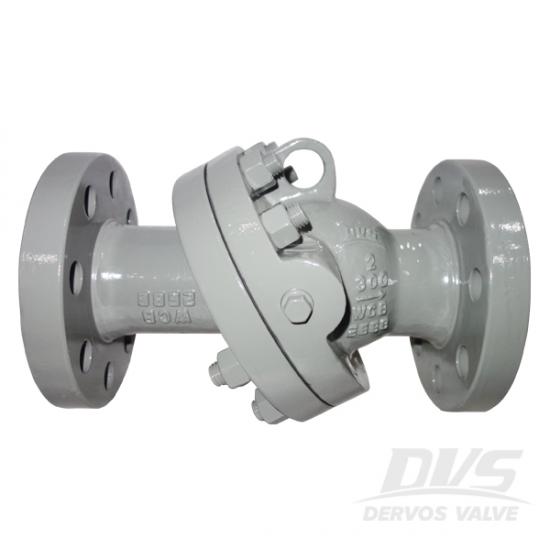
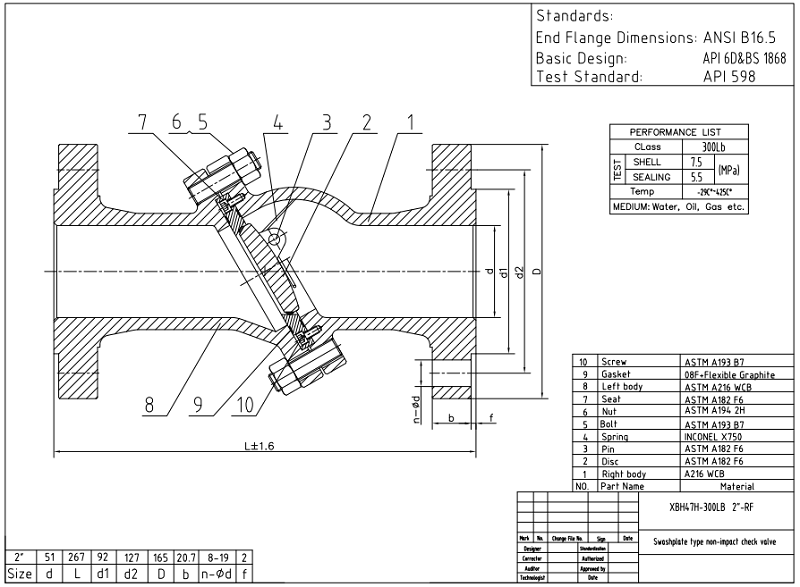
With the RF flange connection, the 2 inch tilting disc check valve is designed as per API 6D and made of carbon steel. It is suitable for the medium pressure up to 300 LB and temperature between minus 29 and 425 Celsius degree.
Quick Detail
|
Type |
Check Valve ( Non-return Valve) |
|
Nominal Diameter |
2’’ |
|
NominalPressure |
300LB |
|
Construction |
Tilting Type Disc |
|
Connection |
RF Flange |
|
Design & Manufacture |
API 6D,BS1868 |
|
End to End |
ASME B16.10 |
|
Flange End Dimension |
ASME B16.5 |
|
Test & Inspection |
API 598 |
|
Temperature Range |
-29℃~+425℃ |
|
Body Material |
Carbon Steel |
|
Media |
W.O.G. |
Technical Drawing
Our Main Product Range
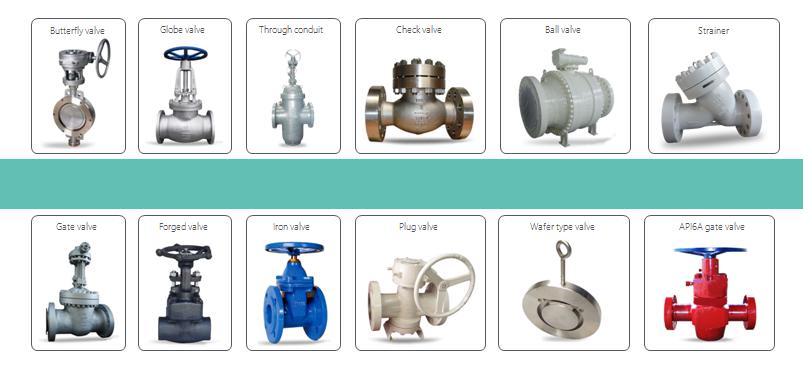
With a complete product range, Dervos product lists cover gate, globe, check, ball, butterfly, check, plug valve and strainers. We can also provide marine valve, pressure reducing valve, control globe valve, wellhead valve and so on.
If you are interested in our products and want to know more details,please leave a message here,we will reply you as soon as we can.
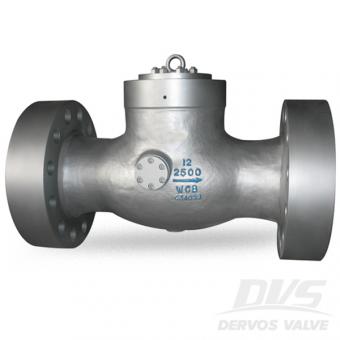
The 12 inch high pressure check valve is designed with pressure seal bonnet, RTJ flange, tilting disc, made of carbon steel WCB body and hard face sealing. Quick Detail Type Check Valve Size 12'' DesignPressure 2500LB Construction Pressure Seal Bonnet, Tilting Disc Type Connection RTJ Flange Design & Manufacture ASME B16.34 End to End ASME B16.10 Connection ASME B16.5 Pressure & Temp ASME B16.34 Test & Inspection API 598 Body Material A216 WCB Trim Material 13CR+STL Temp Range -29℃~+350℃ Media W.O.G. Product Range Body Material Range: WCB, WCC, WC1,CF8M, CF8, CF3, CF3M, LCB, LCC Size Range: 2”~60” (DN50~DN1500) End Connection Type: Flange End, Weld End Design Pressure Range: 150lbs~600lbs Temp Range: -46℃~ +425℃ Related Knowledge What is a tilting disc check valve? The disc of a tilting disc check valve has a pivot point at the center of it. It is desinged to overcome weaknesses of general type swing check valve. Compared to swing type check valve, the tilting check valve could remain fully open and steady at lower flow rates. That is to say, the swing check valve needs a high velocity of fluid to keep disc open and a higher cracking pressure. For low pressure situation, the pressure drop of a tilting disc check valve is much lower than the swing type. But at a higher flow rate, the tilting check valve has higher pressure drop than swing type.
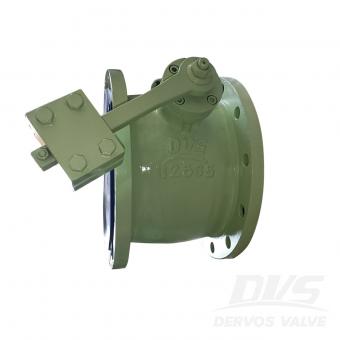
DN250 PN10 check valve body is made of A216 WCB+STL. It has the structural characteristics of heavy hammer on both sides and flange type. Its connection mode is RF.
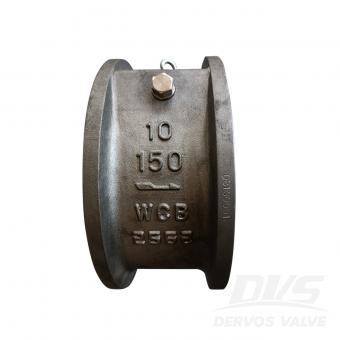
10" 150LB tilting disc check valve is made according to API 6D standard. The valve body is made of A216 WCB+SS316. It has the structural characteristics of swash plate type. Its connection mode is wafer.
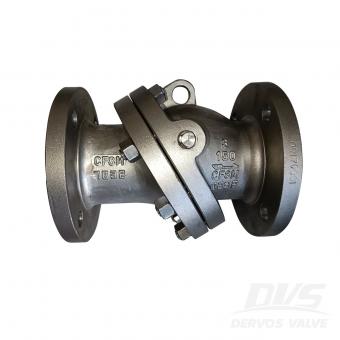
3" 150LB tilting disc check valve is made according to API 6D & BS1868 standard. The valve body is made of ASTM A351 CF8M. It has the structural characteristics of tilting disc type, bolt cover. Its connection mode is RF.
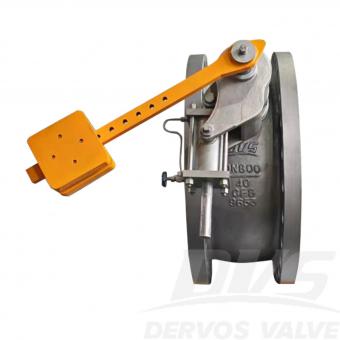
DN800 PN40 Butterfly Type Non-Slam Check Valve is made according to CJ/T 282 standard. The valve body is made of A351CF8+STL. It has the structural characteristics of Equipped with Hydraulic Cylinder and Counterweight. Its connection mode is EF. Product Parameters Type Butterfly Type Non-Slam Check Valve Size DN800 Pressure PN40 Connection EF Body Material A351 CF8+STL Design Norm CJ/T 282 Flange Standard GOST33259 Dimension Standard GB/T12221 Test & Inspection Code GOST9544 A Temperature -45 ~ 248°C Applicable Medium Water Features 1.Butterfly-type non-slam design minimizes water hammer and ensures smooth, rapid closure in large-diameter pipelines. 2.Manufactured in accordance with CJ/T 282, rated PN40 for reliable performance in municipal and industrial systems. Technical Drawing Dimension Checking Pressure Testing Flange Inspection Report
Copyright © 2015-2026 DERVOS VALVE CO.,LTD.All Rights Reserved Blog / Sitemap / XML / Privacy Policy